LLMs in Product Selection for Small E-commerce
The early version of this work was presented at INFORMS Annual Meeting 2025, INFORMS Marketing Science Conference 2026.
Abstract
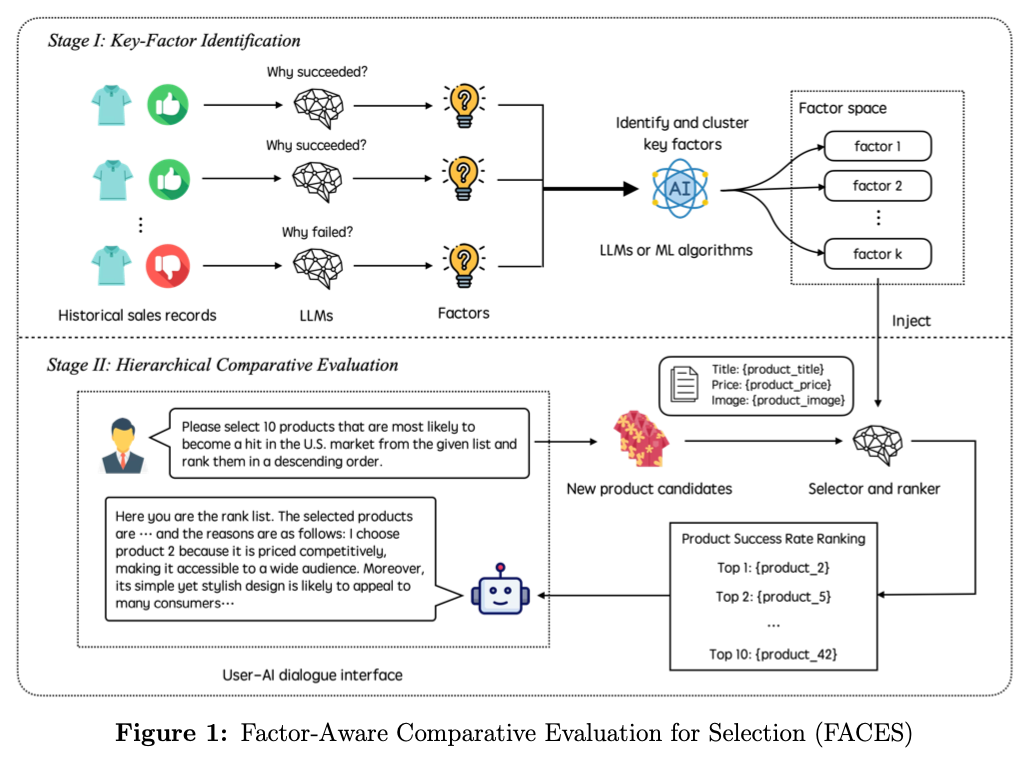
Product selection is critical to the success of small businesses, yet data-driven decision-making is often prohibitively costly in resource-constrained settings. Recent advances in large language models (LLMs) offer a promising alternative for supporting such decisions without requiring extensive data or model training. In this paper, we propose Factor-Aware Comparative Evaluation for Selection (FACES), a training-free, two-stage LLM-based decision framework that emphasizes comparative reasoning rather than pointwise prediction. FACES first induces a compact set of decision factors from historical campaign outcomes and then applies factor-conditioned, hierarchical comparative evaluation within carefully constructed reference groups to rank new candidates. Using real-world data from a representative small e-commerce firm engaged in international trade via Google Ads, we show that LLMs equipped with carefully constructed reference groups and comparative prompts substantially outperform pointwise LLM prompting approaches and competitive machine-learning benchmarks in predicting product-selection outcomes. We further find that larger reference groups can degrade performance, and that alternative information inclusion strategies in reference group construction lead to systematically different decision outcomes. These results provide actionable guidance for small businesses facing cold-start product selection challenges and offer new insights into how LLMs exploit relational structure in decision-making tasks.